


The CPP rate change for 2027 is real and it is legislated. Bill C-30 received Royal Assent on 19 June 2026, cutting the base Canada Pension Plan contribution rate from 9.9% to 9.5% starting in 2027, effective 1 January 2027. If you run payroll in Oshawa, Whitby, Ajax, or anywhere in Durham Region, here is exactly what the CPP rate change means for 2027 budgets, cheques, and CRA remittances.
Key takeaways
- Bill C-30 (Royal Assent 19 June 2026) cuts the base CPP contribution rate from 9.9% to 9.5% starting 1 January 2027.
- In employer paycheque terms, the combined base plus first additional CPP rate drops from 5.95% to 5.75% per side; the first additional CPP portion stays at 1.00%.
- The CPP2 rate stays at 4.00% per side on earnings above the YMPE up to the YAMPE; the 2027 CPP rate change is limited to the base component.
- Finance Canada estimates an employee earning $70,000 saves about $133 in 2027 CPP contributions, with matching savings for their employer.
- CRA publishes the 2027 YMPE and YAMPE in late October or early November 2026, so Durham payroll teams should plan a software table update within 30 days of that release.
What Bill C-30 actually changes about the 2027 CPP contribution rate and maximum pensionable earnings
The Government of Canada's Spring Economic Update 2026, tabled 28 April 2026, proposed a base CPP statutory contribution rate reduction. That measure became law as Bill C-30 on 19 June 2026, following the 33rd Actuarial Report on the Canada Pension Plan (which supplemented the revised 32nd CPP Actuarial Report). The Chief Actuary flagged a minimum contribution rate of 9.5% based on the plan's strong funded position at the end of 2024, and the Finance Minister acted on that actuary's recommendation.
The rate of 9.5% is a 40 basis points reduction from 9.9%. It applies only to the base CPP contribution rate, which is the original pre-enhancement portion of the Canada Pension Plan. The rest of the enhanced CPP structure stays put, as the table below shows.
You will not see the CPP rate change on your last 2026 pay run. Payroll software providers pick up the new rate on the January table update, and CRA's own T4032 payroll deductions tables will refresh with it. Every Ontario employer will deduct at the lower rate starting with the first pay period of 2027.
2026 confirmed CPP contribution rates versus the 2027 rate change
Both years share the same rate structure. The only piece moving is the base component. The 2024 CPP2 launch is unchanged, the 2019 to 2024 enhancement schedule is unchanged, and only the base contribution rate is reset. The YMPE and YAMPE numbers for 2027 are pending until CRA posts them in early November.
| CPP element | 2026 (confirmed) | 2027 (Bill C-30) |
|---|---|---|
| Base CPP contribution rate (combined) | 9.9% | 9.5% |
| Base rate per side | 4.95% | 4.75% |
| First additional CPP rate per side | 1.00% | 1.00% |
| Total base plus first additional per side | 5.95% | 5.75% |
| Basic exemption | $3,500 | $3,500 |
| YMPE | $74,600 | Announced early Nov 2026 |
| CPP2 rate per side | 4.00% | 4.00% |
| YAMPE | $85,000 | Announced early Nov 2026 |
| Maximum employee base plus first additional CPP (at 2026 YMPE) | $4,230.45 | Approximately $4,088.25 |
| Maximum employee CPP2 (at 2026 ceilings) | $416.00 | Approximately $416.00 |
The maximum employee CPP contribution for 2027 will land higher than the amounts in the "approximately" column because the YMPE and YAMPE both rise each year. What is fixed is the rate: 5.75% per side up to the YMPE, 4.00% per side between the YMPE and the YAMPE.
A Bowmanville HVAC shop: what the 2027 CPP rate cut saves on 12 employees
North Durham Heating & Cooling is a fictional Bowmanville HVAC contractor with 12 tradespeople on payroll. To isolate the rate change, hold salaries flat at 2026 levels and use the 2026 YMPE and YAMPE as placeholders. When CRA publishes the 2027 ceilings in early November, plug in the new numbers.
- 2 first-year apprentices at $45,000
- 4 junior technicians at $60,000
- 4 senior technicians at $85,000
- 2 lead technicians at $110,000
| Role | Salary | 2026 employer CPP (5.95%) | 2027 employer CPP (5.75%) | Employer savings |
|---|---|---|---|---|
| Apprentice | $45,000 | ($45,000 – $3,500) × 5.95% = $2,469.25 | ($45,000 – $3,500) × 5.75% = $2,386.25 | $83.00 |
| Junior tech | $60,000 | ($60,000 – $3,500) × 5.95% = $3,361.75 | ($60,000 – $3,500) × 5.75% = $3,248.75 | $113.00 |
| Senior tech | $85,000 | $4,230.45 base + $416.00 CPP2 = $4,646.45 | $4,088.25 base + $416.00 CPP2 = $4,504.25 | $142.20 |
| Lead tech | $110,000 | $4,230.45 base + $416.00 CPP2 = $4,646.45 | $4,088.25 base + $416.00 CPP2 = $4,504.25 | $142.20 |
Rolled up across the 12-person roster:
- 2 apprentices: 2 × $83.00 = $166.00 saved
- 4 juniors: 4 × $113.00 = $452.00 saved
- 4 seniors: 4 × $142.20 = $568.80 saved
- 2 leads: 2 × $142.20 = $284.40 saved
Total employer CPP savings in 2027 for the 12-person shop: $1,471.20. The employees save the same amount off their own paycheques, so the shop-wide combined saving is about $2,940.
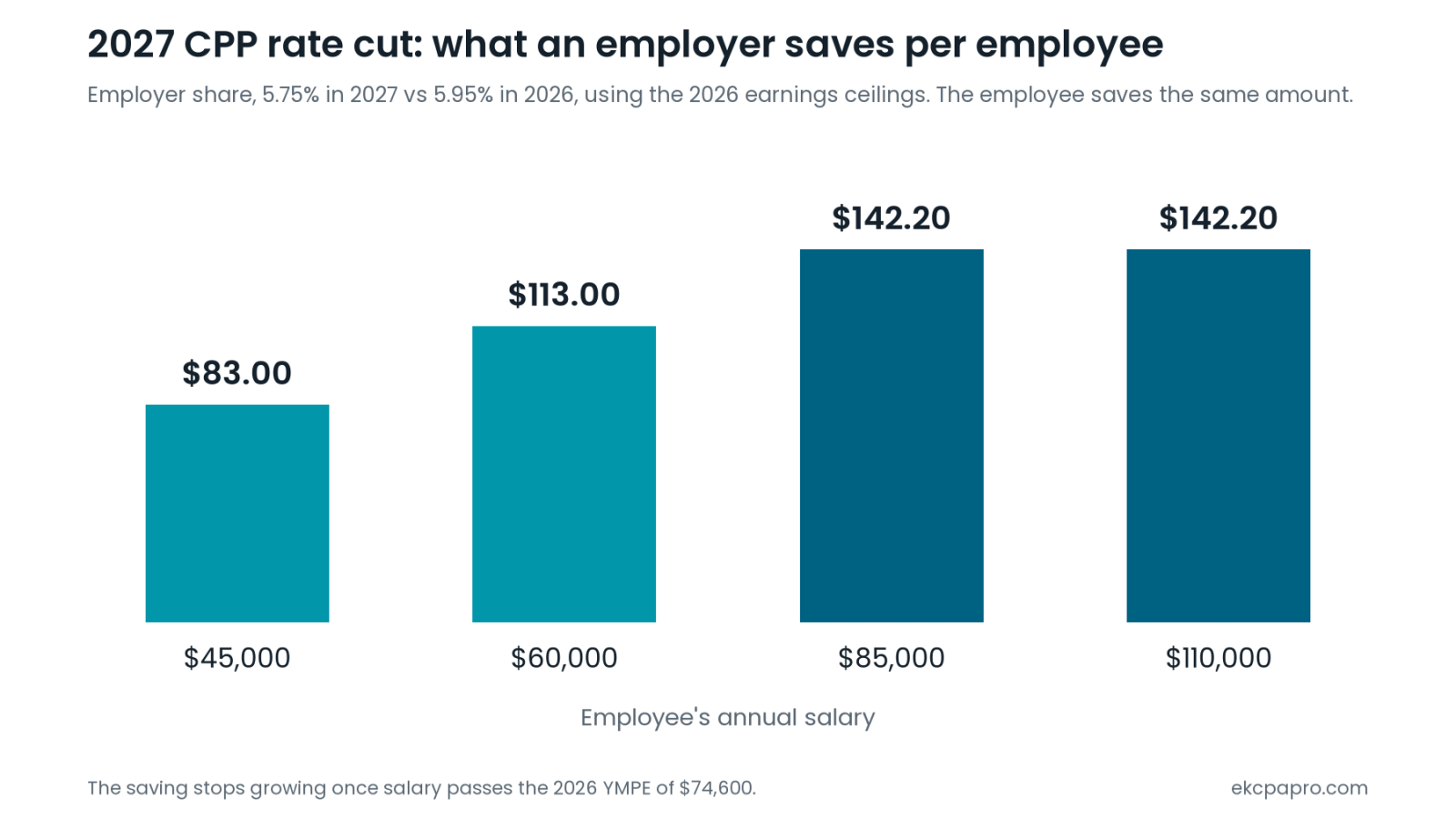
When CRA publishes the 2027 YMPE and YAMPE in November, both ceilings will rise (historically by 3% to 5%). That pushes the maximum contribution amounts up in dollar terms even at the lower rate. The 2027 rate cut is a genuine saving; the higher ceiling absorbs some of it for above-YMPE earners.
If your shop operates in the construction trades or a related field with December bonus payouts, note that a bonus pushing an employee past the YMPE still triggers CPP2 mid-cheque. The rate change does not touch that mechanic.
Self-employed and owner-managers: does the cut change how you pay yourself?
If you are self-employed, you pay both the employee and the employer share of CPP. Your combined base plus first additional rate drops from 11.9% to 11.5% in 2027. At the 2026 ceiling, that is ($74,600 – $3,500) × 0.40% = $284.40 a year. Your CPP2 rate stays at 8% on earnings between the YMPE and the YAMPE.
The same math applies if you own a corporation and pay yourself a salary. Your company pays the employer share and you pay the employee share, so the total saving across you and your company is also $284.40 at the 2026 ceiling. Dividends carry no CPP at all, so the cut makes a salary slightly cheaper compared with dividends.
Our view: $284 a year is not a reason to change your salary and dividend mix. That decision turns on bigger numbers, such as the RRSP room a salary creates (18% of last year's earned income, up to the annual limit), the CPP retirement pension you build, and your corporation's tax rate. CPP contributions are also deductible or earn a tax credit, so the real after-tax saving is smaller than $284.40. If you already pay yourself a salary, keep the plan and take the small saving. If you are reviewing your mix for 2027 anyway, our compensation planning work runs the full comparison.
Five things every Durham Region employer should do before January 2027
- Update your 2027 payroll budget at 5.75% base plus first additional per side, and 4.00% CPP2 per side. Use the 2026 YMPE and YAMPE as a floor until CRA posts the 2027 numbers.
- Bookmark the CRA CPP contribution rates page and check it in the first week of November. The 2026 page was refreshed on 31 October 2025.
- Confirm your payroll software (QuickBooks Payroll, Wagepoint, ADP, Ceridian, or an in-house system) has a documented CPP table update ready for the first pay run of 2027. Most providers push the update automatically. Verify it before your last December run.
- Update employee onboarding paperwork and any total-compensation letters that quote the old 5.95% employee rate. Small detail, but it saves a support call in January.
- Reconcile your 2026 CPP remittances against year-end T4 amounts before you close the books. Errors are cheaper to fix in January than in June after CRA sends a PIER report. Our bookkeeping team does this year-end payroll reconciliation for Durham Region clients.
For the full 2026 numbers you are working with today, see our earlier guide on CPP and EI maximum 2026 payroll deduction rates.
FAQ
When will CRA post the 2027 YMPE, YAMPE, and maximum CPP contributions?
Late October or early November 2026. The 2026 CRA CPP contribution rates page was refreshed on 31 October 2025, and the same window has held for years. The 2027 CPP contribution rate is already known (5.75% per side base plus first additional); only the pensionable earnings ceilings are pending.
I'm self-employed. What do I save in 2027?
You pay both halves of CPP, so your rate drops from 11.9% to 11.5%. At the 2026 ceiling that saves $284.40 a year (the 2026 self-employed maximum was $8,460.90). Your CPP2 rate stays at 8%. You pay CPP with your T1 return or your instalments, not through payroll.
My employee is between 65 and 70 and stopped paying CPP. Does anything change?
No. An employee aged 65 to 69 who receives a CPP or QPP retirement pension and gave you Form CPT30 stays opted out, and you keep not deducting CPP. Employees who did not make that election, including those already collecting their pension, contribute at the new 2027 rate like everyone else. CPP contributions stop for good at 70.
What is the deadline to remit January 2027 CPP contributions at the new rate?
For most Ontario small businesses (regular monthly remitters), CPP withheld from January 2027 pay runs is due by 15 February 2027. Accelerated remitters have shorter windows. Missing a remittance triggers penalties of 3% to 10% of the amount owing plus interest, so calendar the date before year-end.
If you run a business in Oshawa, Whitby, Ajax, Pickering, Clarington, Bowmanville, or Uxbridge and want a second set of eyes on your 2027 payroll budget before CRA posts the new ceilings, we can help. Our advisory team reviews payroll cost projections, catches rate errors before January, and reconciles year-end T4s so the CRA never has to. Book a free 15-minute call to talk through your 2027 numbers.
This article is for general information only and does not replace professional tax advice. Tax rules change, and your specific situation matters. Always confirm with a qualified CPA before making tax decisions.