
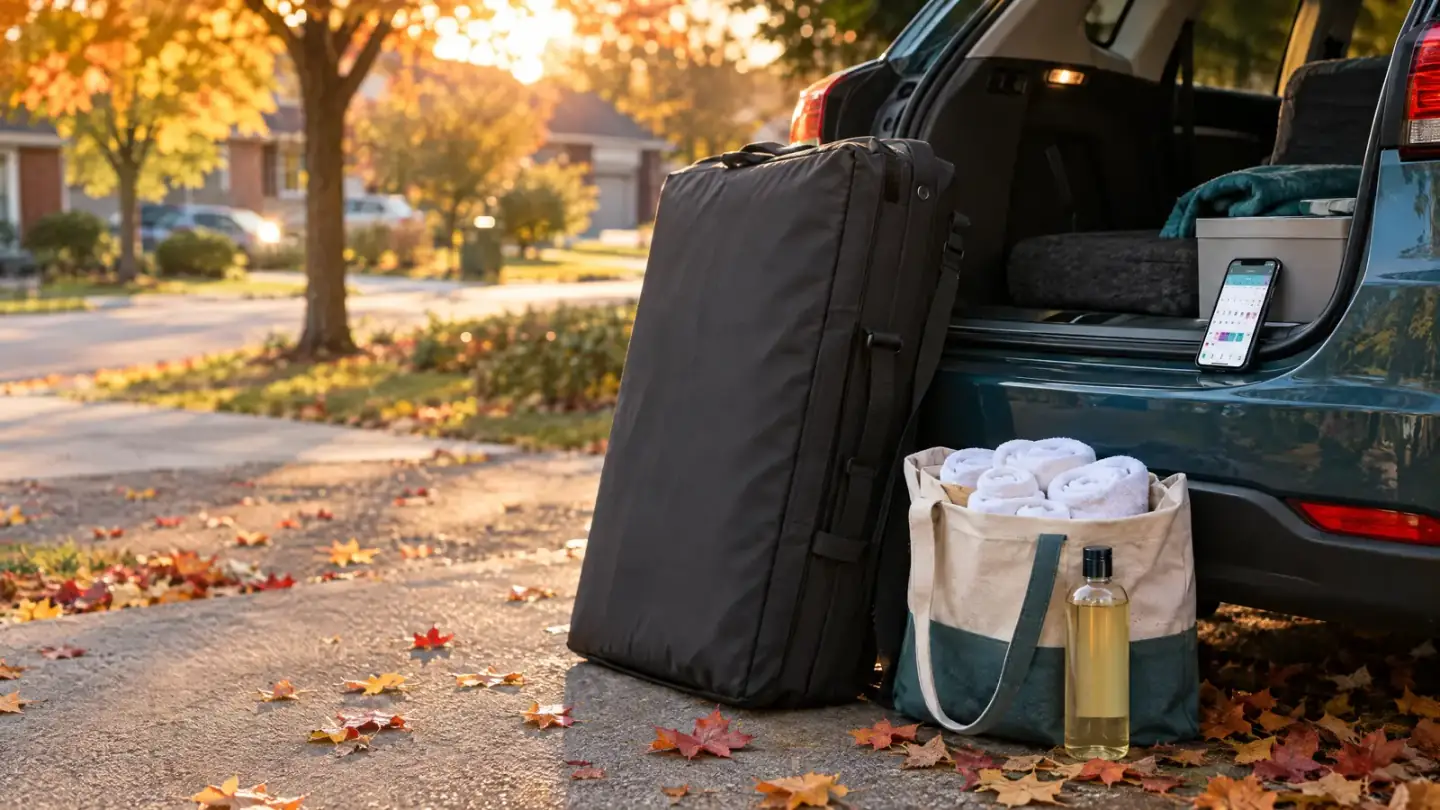
You spent Tuesday driving from a client in Ajax to two more in Pickering, then out to Clarington before dark. Your car is your treatment room on wheels, your spare bedroom is your office, and you bought every towel and drop of oil yourself. If that is your week, you are sitting on a stack of tax deductions most mobile massage therapists and chiropractors in Canada never claim. Here is how to claim them properly for the 2026 tax year.
Key takeaways
- For a solo Registered Massage Therapist (RMT), your massage therapy is a GST/HST-taxable service, and you must register for HST once your revenue passes $30,000 over four consecutive calendar quarters.
- Chiropractic services are GST/HST-exempt, so a mobile chiropractor does not charge HST and generally cannot claim input tax credits on purchases.
- Your car is usually the biggest deduction in a mobile practice. You deduct your business-use percentage of actual vehicle costs, based on a kilometre logbook, not a flat per-kilometre rate.
- A portable massage table and tools are Class 8 equipment (20% capital cost allowance), and small purchases may qualify for immediate expensing in the year you buy them.
- Home base costs, supplies, professional dues and liability insurance are all deductible business expenses on form T2125.
What surprises new mobile RMTs: massage is HST-taxable
Start here, because getting HST wrong is expensive. Many people assume a health service is automatically tax-free. For massage therapy, that is not the case.
Under the Excise Tax Act, only services rendered by listed health practitioners are exempt. Massage therapists are not on that list, so a supply of massage therapy on its own is taxable, even when you are a Registered Massage Therapist in a province that regulates the profession. The Canada Revenue Agency (CRA) sets out which health services are exempt on its charge and collect page, and massage therapy is not among them.
What that means in practice:
- You must register for GST/HST once your taxable revenue crosses $30,000 over any single calendar quarter or four consecutive quarters. Below that you are a small supplier and registration is optional.
- Once registered, you charge 13% HST on your Ontario sessions and remit it.
- The upside: as a taxable business, you can claim input tax credits to recover the HST you pay on oils, linens, your table, fuel and other business costs.
Chiropractors are the opposite. Chiropractic services are exempt, so a mobile chiropractor (see our accountant for chiropractors page) does not charge HST on treatments and, because those sales are exempt, generally cannot claim input tax credits on the HST they pay for supplies. If you run a mixed practice, the split gets technical fast, and it is a good time to talk to a CPA.
Motor vehicle expenses: the biggest deduction in a mobile practice
If your treatment room is your car, the drive between clients is where your largest deduction lives. The rule for a self-employed practitioner is simple to say and easy to get wrong: you deduct the business-use share of your real vehicle costs.
Two numbers drive it, and the CRA wants a logbook that proves both:
- Business kilometres: every kilometre driven to earn income, such as home base out to a client in Whitby and on to the next in Oshawa.
- Total kilometres: everything the car drove that year.
Your business-use percentage is business kilometres divided by total kilometres. You apply that percentage to your total vehicle costs. Deductible costs include fuel, oil, insurance, licence and registration, maintenance and repairs, and loan interest. Capital cost allowance on the vehicle is claimed on its own line.
A quick clarification that saves people a lot of grief. The CRA's 2026 reasonable per-kilometre rate is 73 cents for the first 5,000 kilometres and 67 cents after that. That flat rate is for employees who receive an allowance from an employer. As a self-employed RMT or chiropractor, you do not use it. You use the business-use percentage of your actual costs instead.
On records, the CRA accepts two approaches under its motor vehicle records rules. Keep a full logbook for a complete year, or keep one full base-year logbook and then use a three-month sample each year after, as long as your driving stays within 10% of the base year. A booking app that timestamps each appointment makes the logbook almost automatic. Our bookkeeping team sets this up for a lot of Durham practitioners before tax time.
Your home base: business-use-of-home for a mobile practitioner
You may not treat clients at home, but you almost certainly run the business from there. You store linens, sanitize equipment, do laundry, keep records and take bookings from one room. That space counts.
A self-employed person can deduct business-use-of-home expenses when the space is the principal place of business, which a mobile practice run from home usually is. You deduct a reasonable share of heat, hydro, home insurance, property tax, mortgage interest and maintenance, based on the room's floor area against your whole home. The CRA explains the method on its business-use-of-home page.
One limit to know. Home office expenses cannot create or increase a business loss. If your claim is larger than your net income for the year, you carry the unused part forward and deduct it in a future year with enough income.
Portable equipment and CCA: your table, tools and the write-off timing
Big-ticket gear is not a one-line deduction. Your portable massage table, a hydraulic stool, an adjusting bench or a portable ultrasound unit are capital property. You deduct the cost over time through capital cost allowance (CCA).
A massage table and general tools fall into Class 8, which is deductible at 20% on a declining-balance basis, and the half-year rule applies in the year you buy (you claim CCA on half the cost that first year). The CRA covers this in its CCA folio. Immediate expensing rules can let an eligible sole proprietor write off qualifying equipment in full the year it is bought, which is often better for a small practice. A CPA will tell you which path leaves you further ahead. That is accounting work worth a five-minute conversation.
Small consumables are different. Oils, lotions, linens, table paper, sanitizer and laundry detergent for client linens are current expenses. You deduct the full business cost in the year you buy them, not over time.
The deductions mobile practitioners miss most
A comparison of what is fully deductible, what is partly deductible, and what is not.
| Expense | Deductible? | Notes |
|---|---|---|
| Vehicle costs (fuel, insurance, repairs) | Business-use % only | Needs a kilometre logbook |
| Massage table, tools, adjusting bench | Yes, over time | Class 8 CCA, or immediate expensing if eligible |
| Oils, linens, sanitization supplies | Yes, in full | Current expense in the year bought |
| Home base (heat, hydro, property tax) | Business-use % only | Cannot create or increase a loss |
| Professional college and association dues | Yes | Required to practise |
| Liability and malpractice insurance | Yes | Deducted as business insurance |
| Phone and booking software (Jane, Acuity) | Business-use % | Split out personal use |
| Continuing education and certifications | Usually yes | Must relate to your current practice |
| Your own massage or chiropractic treatments | No | Personal, not a business expense |
| Everyday clothing | No | Even branded athletic wear |
Professional dues to your provincial college, your association membership, and your liability or malpractice insurance are all deductible business expenses. So are your work phone and booking software, split for any personal use.
A Durham worked example: a mobile RMT across Ajax, Pickering and Clarington
Meet Priya, a self-employed RMT based in Ajax who treats clients in their homes across Ajax, Pickering and Clarington. In 2026 she billed $71,000, so she is registered for HST and charges it on her sessions. Here is how her deductions land.
| Expense | Amount |
|---|---|
| Vehicle: $6,320 total costs at 75% business use (16,500 of 22,000 km) | $4,740 |
| Home base: $18,000 of eligible home costs at 10% floor area | $1,800 |
| Portable table and stool, immediate expensing | $1,150 |
| Oils, linens, sanitization supplies | $1,420 |
| College dues, association, liability insurance | $1,060 |
| Phone and booking software, business share | $780 |
| Total business deductions | $10,950 |
Priya's deductions cut her net business income from $71,000 to about $60,050 before tax. At her 2026 combined federal and Ontario marginal rate of roughly 29.65%, that $10,950 in deductions is worth about $3,247 less tax. The logbook, the receipts and the home-office measurement are what turn a guess into a number the CRA will accept if it ever looks.
What about your clients? The medical expense angle
Your clients often ask if they can write off your sessions, and the answer shapes how you invoice. Massage therapy can qualify for the Medical Expense Tax Credit (METC) on a client's personal return, but only when the therapist is authorized in that province. In Ontario, RMTs are authorized, so your Ontario clients can include your receipts in their medical expenses. Give every client a clear receipt with your name, registration number, the date and the amount. It is a small habit that makes you the practitioner clients keep coming back to at tax time.
Frequently asked questions
Can I write off massages on my taxes in Canada?
It depends who is asking. As a self-employed massage therapist, your own personal massages are not a business expense. Your clients, though, may claim your sessions as a medical expense on their personal return if you are an authorized practitioner in their province, which RMTs are in Ontario. And as a practitioner, the real deductions are your business costs: vehicle, home base, equipment, supplies, dues and insurance.
What expenses can a mobile massage therapist claim as tax deductions?
The main ones are the business-use share of your vehicle, business-use-of-home for the room you run the practice from, capital cost allowance or immediate expensing on your table and tools, and current expenses like oils, linens, sanitization, professional dues, liability insurance, and your work phone and booking software. Keep a receipt and a logbook for everything.
Do RMTs charge HST in Canada?
Yes, once you pass the small-supplier threshold. Massage therapy supplied on its own is a GST/HST-taxable service, so a Registered Massage Therapist must register and charge HST after billing more than $30,000 of taxable revenue over four consecutive calendar quarters. Chiropractic services are exempt, so a chiropractor does not charge HST.
How do I track mileage for my mobile massage or chiropractic practice?
Keep a logbook that records the date, destination, purpose and kilometres of every business trip, plus your total kilometres for the year. Your business-use percentage is business kilometres divided by total kilometres, and you apply it to your actual vehicle costs. After one full base-year logbook, you can use a three-month sample in later years if your driving stays within 10% of the base year.
Get your mobile-practice deductions claimed right
We work with mobile massage therapists, RMTs and chiropractors across Ajax, Pickering, Whitby, Oshawa, Clarington and Uxbridge. If you want to know whether you are registered for HST correctly, or you just want last year's mileage and home-office claim done right, book a free 15-minute call and we will walk through your numbers before you file.
This article is for general information only and does not replace professional tax advice. Tax rules change, and your specific situation matters. Always confirm with a qualified CPA before making tax decisions.