

You took $12,000 out of your TFSA (tax-free savings account) in September for a car or a kitchen, the plans changed and now you want to put it back. Can you? The TFSA withdrawal recontribution rules say yes, but only at the start of next year, unless you already have unused room. Put it back too early and you pay 1% a month on the excess. Here is how the timing works, and how to avoid the tax.
Key takeaways
- A TFSA withdrawal made in 2026 is added back to your TFSA contribution room on 1 January 2027, not on the day you withdraw.
- You can only re-contribute in the same calendar year if you already have unused TFSA contribution room; the 2026 TFSA contribution limit is $7,000.
- The TFSA over-contribution penalty is 1% per month on the highest excess TFSA amount in each month, so a $12,000 excess left in for two months costs $240.
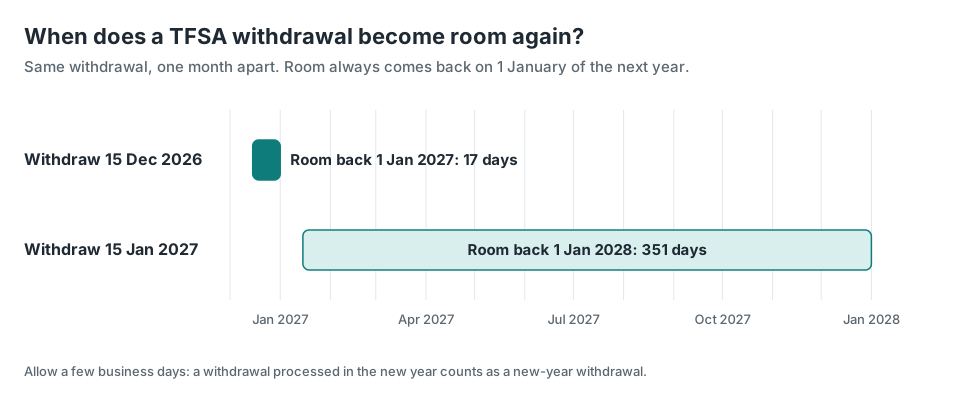
- A withdrawal made on 15 December 2026 comes back as room 17 days later, on 1 January 2027; the same withdrawal made on 15 January 2027 waits until 1 January 2028.
- Moving a TFSA between banks by direct transfer leaves your contribution room unchanged; withdrawing $50,000 and re-depositing it yourself with no room creates a $50,000 excess taxed at $500 a month.
How TFSA withdrawals work and affect your contribution room
You can make a withdrawal from your TFSA at any time, and the money comes out tax-free. There is no limit on how much you can withdraw, other than the terms of the investment itself (a locked-in GIC, for example). What TFSA withdrawals do not do is give you new room right away.
The rule is simple: the amount you withdraw is added back as available contribution room on 1 January of the next calendar year. So money withdrawn in 2026 only comes back in 2027. On that same date, the contribution limit for the new year is added too.
Your TFSA contribution room at any moment is:
| Part of the calculation | What counts |
|---|---|
| Plus | The annual TFSA dollar limit for the current year ($7,000 in 2026) |
| Plus | Unused contribution room carried forward from earlier years |
| Plus | Withdrawals made in the previous year |
| Minus | Contributions already made this year |
If you were 18 and a resident of Canada in 2009 and have never contributed, your total room on 1 January 2026 is $109,000. Every contribution uses room immediately. TFSA withdrawals only give it back the following year.
TFSA withdrawal rules for re-contribution in the same year
Putting money back in the same year is fine in one case: you have unused contribution room that covers it. If you contributed $3,000 of your $7,000 limit in 2026 and then withdraw $3,000, you can put $3,000 back this year because you still have $4,000 of unused room. Only $4,000 though. The $3,000 withdrawal itself does not count until next year.
If you have no unused room, anything you contribute to your TFSA is an over-contribution, even if it is your own money going back in. It does not matter that you "only borrowed it." The TFSA withdrawal and the deposit that follows are two separate transactions.
When clients bring us the CRA's letter about an excess, most of them did not know this rule: money taken out of a TFSA cannot simply go back in the same year.
The TFSA over-contribution penalty: 1% per month
An excess TFSA amount is taxed at 1% per month. The tax applies to the highest excess in your account during each month the excess exists. It is not prorated by day.
That last point matters. If you over-contribute $2,000 on 3 June and remove it on 28 June, you owe $20 for June. If you remove it on 2 July instead, you owe $20 for June and $20 for July. Removing part of the excess does not help for that month either: the tax is charged on the highest amount in the account that month.
You do not need to wait for a letter. Withdraw the excess as soon as you spot it, then file Form RC243 (the TFSA Return) and Schedule A by 30 June of the following year. The CRA usually sends a notice in late spring, after banks report the prior year's transactions in February. Deliberate over-contributions may be taxed at 100% under the advantage rules, so this is not a loophole to play with.
Worked example: an Ajax renovation that cost $240
Dana lives in Ajax. She has contributed the maximum every year since 2009, including the full $7,000 for 2026. Her unused contribution room is $0.
- In September 2026 she withdraws $12,000 from her TFSA for a basement renovation deposit.
- In October 2026 the contractor pushes the job to spring, so Dana puts the $12,000 back into her TFSA. With nothing left to use, that is a $12,000 excess TFSA amount.
- In November 2026 her bank statement flags the over-contribution, and she withdraws the $12,000 the same month.
| Month | Highest excess in the account | Tax at 1% |
|---|---|---|
| October 2026 | $12,000 | $120 |
| November 2026 | $12,000 | $120 |
| Total | $240 |
Here is Dana's contribution room at each step, using the formula above:
| Date | What happened | Dana's contribution room |
|---|---|---|
| 1 January 2026 | 2026 limit of $7,000 added, then her usual full contribution | $0 |
| September 2026 | Withdraws $12,000 | Still $0 (the $12,000 waits for 1 January 2027) |
| October 2026 | Puts the $12,000 back | Minus $12,000 (an excess) |
| November 2026 | Takes the $12,000 out again | $0, but October and November are already taxed |
| 1 January 2027 | Both 2026 withdrawals ($24,000) come back, less the $12,000 she put back in October, plus the 2027 limit | $12,000 plus the 2027 limit |
Dana owes $240 and has to file RC243 with Schedule A by 30 June 2027. If she had parked the money in a regular savings account and waited until 1 January 2027, when her withdrawal comes back as room, she would owe nothing.
Had Dana kept $5,000 of unused room, the same deposit would have created a $7,000 excess, and the TFSA tax would be $70 a month instead of $120.
What an over-contribution costs
The tax is the excess times 1% for each month it sits in the account, counting any month it is there at all.
| Excess TFSA amount | 1 month | 3 months | 6 months |
|---|---|---|---|
| $2,000 | $20 | $60 | $120 |
| $7,000 | $70 | $210 | $420 |
| $12,000 | $120 | $360 | $720 |
| $50,000 | $500 | $1,500 | $3,000 |
Most of the cost comes from not noticing. Remove the excess the day you find it.
When TFSA withdrawals count: December or January
Because TFSA withdrawals only turn back into room at the start of each year, the month you withdraw changes how long you wait. If you know you will need money from your TFSA early next year, withdraw it in December instead.
| Withdrawal date | Room comes back | Wait before you can re-contribute |
|---|---|---|
| 15 December 2026 | 1 January 2027 | 17 days |
| 31 December 2026 | 1 January 2027 | 1 day |
| 15 January 2027 | 1 January 2028 | about 11.5 months |
Do not leave it to the last day. Banks need a few business days to process a withdrawal, and one that goes through in the new year counts as a 2027 withdrawal. The 2027 contribution limit has not been published yet, so check the CRA's page in late fall before you plan around it.
Do not withdraw from a TFSA to switch banks
Switching banks for a better rate is an easy way to create an over-contribution by accident. If you withdraw funds from Bank A and deposit them at Bank B yourself, the deposit is treated as a new contribution. If you have no unused room, the whole amount is an excess.
Instead, open a TFSA at the new bank and ask it to do a direct transfer. A direct transfer does not affect your TFSA contribution room. You can move investments as they are (in kind), sell first and move the cash, or move only part of the account. Some institutions charge a transfer fee.
If your spouse gave you the money for your TFSA, separate rules apply to gifts between spouses. See our guide on whether gifted money is taxable in Canada.
Check your TFSA contribution room with your own records
CRA My Account updates TFSA information once a year, in the spring, after banks report the previous year's transactions by the end of February. The room it shows early in the year can miss everything you did last year, and it never shows what you did this year.
Before you withdraw from your TFSA or put money back, add up your own bank and brokerage records across every TFSA you hold, using the RC343 worksheet. If the CRA's figures look wrong, ask your TFSA issuer to send an amended report.
Should you put the money back at all?
Waiting until 1 January is only the first question. Where the money goes next depends on what it is for.
| Your situation | Where the money can go | Why |
|---|---|---|
| You will need it again within a year or two | A regular savings account until 1 January, then back into the TFSA | No over-contribution risk now, and the room is waiting for you in January. Interest earned outside the TFSA in the meantime is taxable. |
| It is long-term savings and your income is high this year | Your RRSP first, if you have RRSP room | The RRSP deduction lowers this year's tax. Withdrawals later are taxed as income, so it suits money you will not touch until retirement. |
| You are saving for your first home | Your FHSA (first home savings account), if you qualify | You get a deduction going in and a tax-free withdrawal for a qualifying home purchase. The limit is $8,000 a year, up to $40,000 in total. |
If you are not sure which fits, that is a 15-minute conversation, not a guess.
FAQ
Can I withdraw from my TFSA and put it back in the same year?
Only if you already have unused contribution room to cover it. The amount you withdraw is added back at the start of the following year. Money you put back before then uses your existing room, and anything beyond it is taxed at 1% per month.
How much is the TFSA over-contribution penalty?
It is 1% per month on the highest excess TFSA amount in each month. A $5,000 excess costs $50 a month, and the tax applies for the full month even if you remove the excess a few days in. You report it on Form RC243 by 30 June of the next year.
Do TFSA withdrawals count as income?
No. Withdrawals from your TFSA are tax-free and are not reported as income on your T1 return. They do not reduce income-tested benefits such as the Canada child benefit, Old Age Security or the GST/HST credit.
Is there a limit on how much I can withdraw from my TFSA?
No. You can withdraw any amount at any time, subject only to the terms of the investment you hold. Withdrawing does not make you lose your contribution room either. The limit applies to putting money back, and that is set by your available contribution room.
Get your TFSA room checked before you put money back
Not sure how much you can put back, or already over-contributed? We help individuals and families across Oshawa, Whitby, Ajax, Pickering, Clarington, Bowmanville and Uxbridge sort out their personal tax and savings plans, including the RC243 filing if an excess slips through. A short call can save you months of 1% charges.
This article is for general information only and does not replace professional tax advice. Tax rules change, and your specific situation matters. Always confirm with a qualified CPA before making tax decisions.